
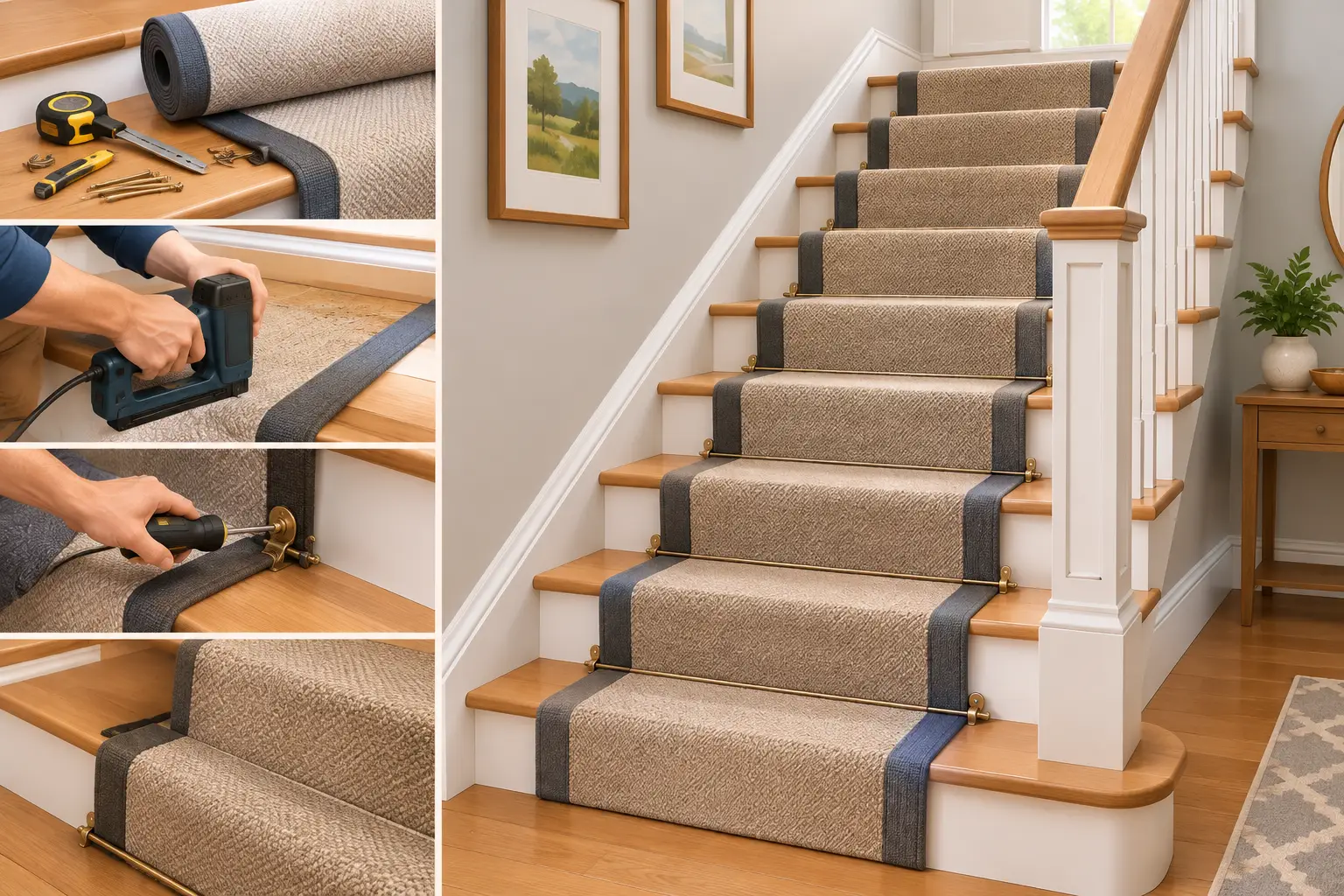
A stair runner can change the feel of an entry or upstairs hallway before anyone reaches the second floor. It softens footfall, adds traction to slick hardwood treads, and gives a dated staircase a tailored finish without covering the wood entirely. But to install stair runners well, the details matter: centered layout, secure edges, proper padding, and a clean finish at every riser.
For many Northern Virginia homeowners, stairs are one of the most visible transitions in the home. A runner that is slightly off-center, wrinkled at the nosing, or poorly secured will stand out just as quickly as a well-installed one. Here is what goes into a durable, polished installation and when it makes sense to bring in a professional.
Start With the Staircase, Not the Runner
Before choosing a pattern or color, inspect the stairs themselves. Every tread should be solid, dry, clean, and free of loose nails, peeling finish, or movement. Carpet cannot correct a squeaky tread or hide a damaged stair edge for long. Addressing those conditions first gives the runner a stable surface and helps prevent premature wear.
The staircase shape also affects the scope of the project. Straight staircases are the most straightforward. Winders, curved stairs, open-sided steps, landings, and stairs with decorative spindles require more precise measuring and cutting. A runner can be installed in either a waterfall style, where it runs straight down from tread to riser, or a tailored cap-and-band style that follows the contour of each tread and riser.
Waterfall installation is often a clean choice for simple, square-edged stairs. Tailored installation creates a more fitted appearance and is commonly preferred on stairs with a pronounced bullnose or when a more traditional look is desired. Neither is automatically better. The right method depends on the stair profile, runner material, and the finished look you want.
Choose a Runner Built for Daily Use
Stair runners work harder than most area rugs. They face concentrated traffic, pet claws, shoes, vacuuming, and repeated pressure at the front edge of every tread. The best choice is usually a low-profile, dense carpet with a durable backing and a pattern that can handle everyday activity.
Wool is a popular premium option because it wears well, resists crushing, and brings natural texture to a staircase. Wool blends can offer a similar appearance at a more moderate cost. Synthetic runners, including nylon and polypropylene options, can be practical for busy households, especially when stain resistance and budget are priorities.
Pattern deserves as much consideration as fiber. Small geometrics, subtle stripes, and textured neutrals can help conceal everyday wear. Large-scale patterns can look striking, but they demand careful alignment from one stair to the next. If a runner has a directional stripe or border, order enough material for pattern matching and allow for waste. Saving a few feet of material at the estimate stage can result in a compromised layout later.
Color should connect the stairs to nearby flooring and walls, not necessarily match them exactly. A warm gray, soft taupe, deep blue, or natural woven texture can create contrast against hardwood while still fitting the home. An in-home selection appointment is especially useful here because lighting can shift dramatically between a sunny foyer, a shaded landing, and an upstairs hall.
Measure Carefully Before You Install Stair Runners
Measuring is where many do-it-yourself stair runner projects go wrong. Do not measure only the visible tread depth and multiply it by the number of steps. Each stair requires material across the tread, around the nosing, and down the riser. Add the landing or hallway sections, plus extra length for cuts, pattern matching, and finishing.
First, decide on the runner width. Most runners are narrower than the full stair width so the wood remains visible on both sides. The exposed wood should appear balanced from step to step. On a typical staircase, a runner may leave several inches of wood visible on each side, but the exact width should be based on the staircase and runner proportions rather than a fixed rule.
Find the center point of each tread and mark it lightly. Then measure from that center point outward to confirm the runner will have equal reveals on both sides. Older homes can have stairs that vary slightly in width. In those cases, visual centering is more important than relying on one measurement taken at the bottom step.
For patterned runners, lay out the material before making final cuts. Make sure the motif or stripe is straight and repeats consistently. A runner that is centered at the first step but gradually shifts off line by the top is one of the most noticeable installation errors.
Padding Makes the Runner Feel Better and Last Longer
A stair runner needs padding, but not the thick cushion used beneath wall-to-wall carpet. Thick padding can make the runner unstable and may prevent it from wrapping tightly around the stair nose. Choose a dense, low-profile carpet pad designed for stairs.
Quality padding improves comfort, reduces noise, and absorbs some of the impact that would otherwise flatten carpet fibers. It also helps the runner sit more smoothly against the tread. The pad should be slightly narrower than the runner so it does not show at the edges.
Install padding in separate pieces on each tread rather than trying to run one continuous strip down the staircase. Each piece should stop short of the tack strip and should not wrap over the front edge of the step. This approach keeps the stair nose defined and helps create a secure, tailored finish.
The Installation Details That Keep It Secure
Professional stair runner installation generally uses tack strips, staples, and careful tensioning. Tack strips are positioned near the back of each tread and at the base of the riser, with the pins facing toward the joint where the tread meets the riser. The runner is stretched onto these strips so it remains tight rather than shifting underfoot.
Staples are placed strategically, typically tucked into the crease between the tread and riser or concealed close to the side edges. They should not be visible from a normal standing position. The installer works from the bottom upward, maintaining alignment and tension at every step.
At each stair nose, the runner must be pulled firmly around the edge without puckering. Too little tension can cause the carpet to loosen over time. Too much force, especially on a delicate woven runner, can distort the pattern or damage the material. This is one reason custom-cut runners and striped goods are often best handled by an experienced installer.
Finishing the top and bottom of the staircase is equally important. The ends may be turned and tucked, finished against a threshold, or transitioned onto a landing. The correct method depends on whether the runner ends at hardwood, carpet, tile, or another surface. Clean transitions protect the edges and make the staircase look intentional rather than added on.
Common Mistakes to Avoid
The most common issue is uneven spacing along the sides of the stairs. It may seem minor at first, but it becomes obvious when the staircase is viewed from below. Marking a centerline and checking each step prevents this problem.
Another mistake is using an overly thick pad or relying on adhesive alone. Adhesive may be suitable for certain specialty applications, but it is not a substitute for proper mechanical fastening and tensioning on a busy residential staircase. Loose carpet is not just unattractive. It can become a trip hazard.
Homeowners also sometimes choose a runner based only on its appearance in a showroom sample. A light, looped wool design may be beautiful, but it may not be the easiest choice for a household with large dogs, young children, or frequent outdoor traffic. Discussing wear expectations before ordering helps balance style, maintenance, and cost.
Finally, do not overlook stair preparation. If refinishing hardwood stairs, completing repairs, or replacing trim is part of the project, schedule that work before the runner is installed. Trying to sand, stain, or repair around a finished runner creates unnecessary risk and expense.
When Professional Installation Is Worth It
A capable homeowner may be able to install a simple runner on a short, straight staircase with the right tools and patience. The trade-off is that stairs leave little room for error. The materials can be costly, and correcting a misaligned pattern or damaged edge may require replacing more runner than expected.
Professional installation is especially worthwhile for winding stairs, wide staircases, high-end wool goods, bordered runners, patterned materials, and projects that involve hardwood refinishing or new flooring nearby. An experienced team can measure the staircase, recommend a suitable runner and pad, prepare the surface, manage transitions, and complete the finishing work as one coordinated project.
For homeowners who want the look without the installation guesswork, Floorsbay can help match a runner to your flooring, interior style, and everyday needs. The goal is not simply to cover the steps. It is to create a safer, quieter staircase that looks at home with the rest of your space for years to come.